
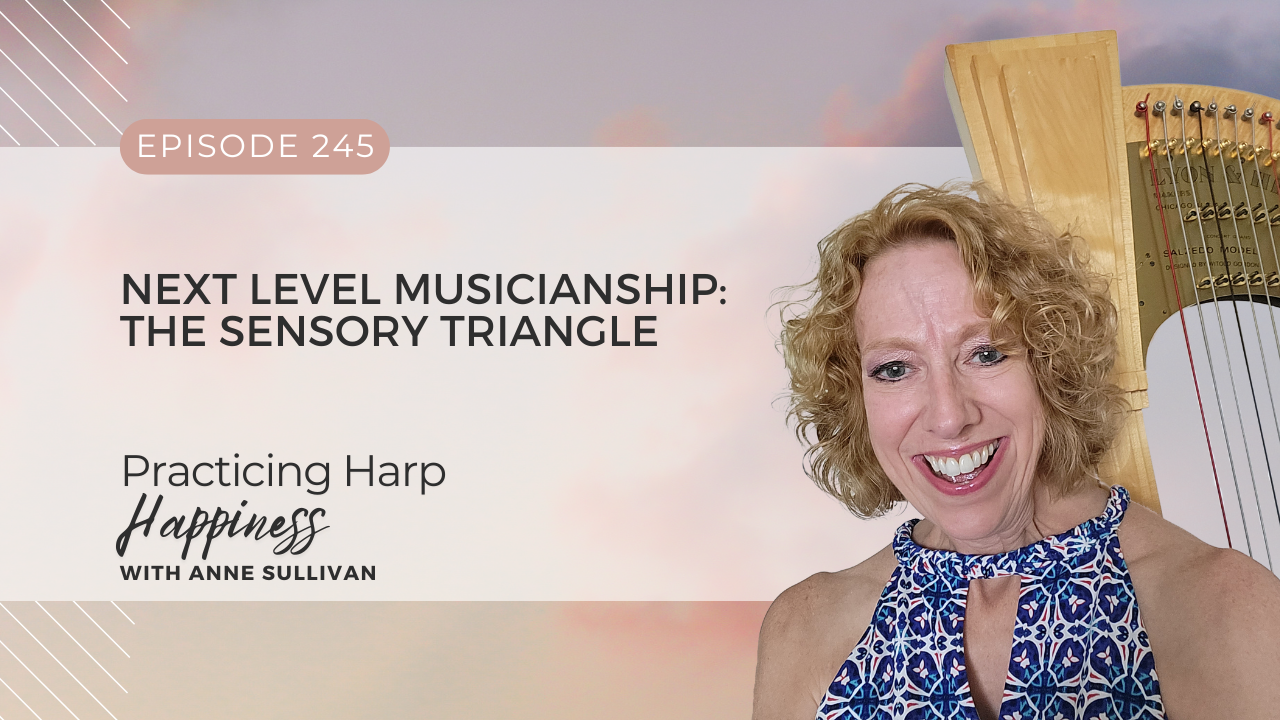
#245: Next Level Musicianship: The Sensory Triangle
Jan 19, 2026If you’ve listened to me for a while or taken any of my classes or workshops, you know that I love finding the solutions to problems we harpists face and creating the step by step plans to take action to solve them. I’ve discovered over my years of teaching that it’s not hard to define the problem, at least the surface problem. For instance, if your left hand can’t play the notes in two specific measures of your piece, then that’s the problem, and the solution is easy: drill the notes.
Sometimes, however, the real issue lies a few layers down. Maybe the reason the left hand can’t play those measures isn’t the notes. Perhaps there is a technical issue, or maybe reading bass clef is the sticking point. It could be a counting issue or even not quite understanding what the meaning of the music is at that moment. So when I’m working with my Gold Circle students, we often spend some time digging a little deeper to see where the real issue is. Then we can define the proper steps to address it.
I’m mentioning this, not because we’re going to talk about solving problems today, at least not exactly. What I want to point out is that music study isn’t as linear as we would like it to be. It would be terrific if we could practice a piece, put extra time on the hard spots, polish it up and play it, but we all know that it doesn’t always work that way. That’s because when we play music, we are using a very complex set of skills that involves much more than just playing with our best technique or learning the notes. This is the skill set that comes under the heading “musicianship.”
In today’s podcast episode, I want to talk about the specific musicianship skills we use everyday in our playing and how to keep them growing and developing. These skills are truly key to your growth as a harpist. I’ll help you understand how they connect to each other and to your playing, and we’ll talk about how to integrate more intentional musicianship skill development into your daily practice. And we’ll do that using a concept I developed called the Sensory Triangle.
Links to things I think you might be interested in that were mentioned in the podcast episode:
- The Harpists' Breakthrough Blueprint Intensive
- Cracking the Code: The Better Way to Read Music blog post
- Harpmastery.com
Get involved in the show! Send your questions and suggestions for future podcast episodes to me at [email protected]
Looking for a transcript for this episode? Did you know that if you subscribe to this podcast on Apple Podcasts you will have access to their transcripts of each episode?
Don't miss anything!
Sign up to receive newsletters, course offerings and updates to your inbox!
We hate SPAM. We will never sell your information, for any reason.