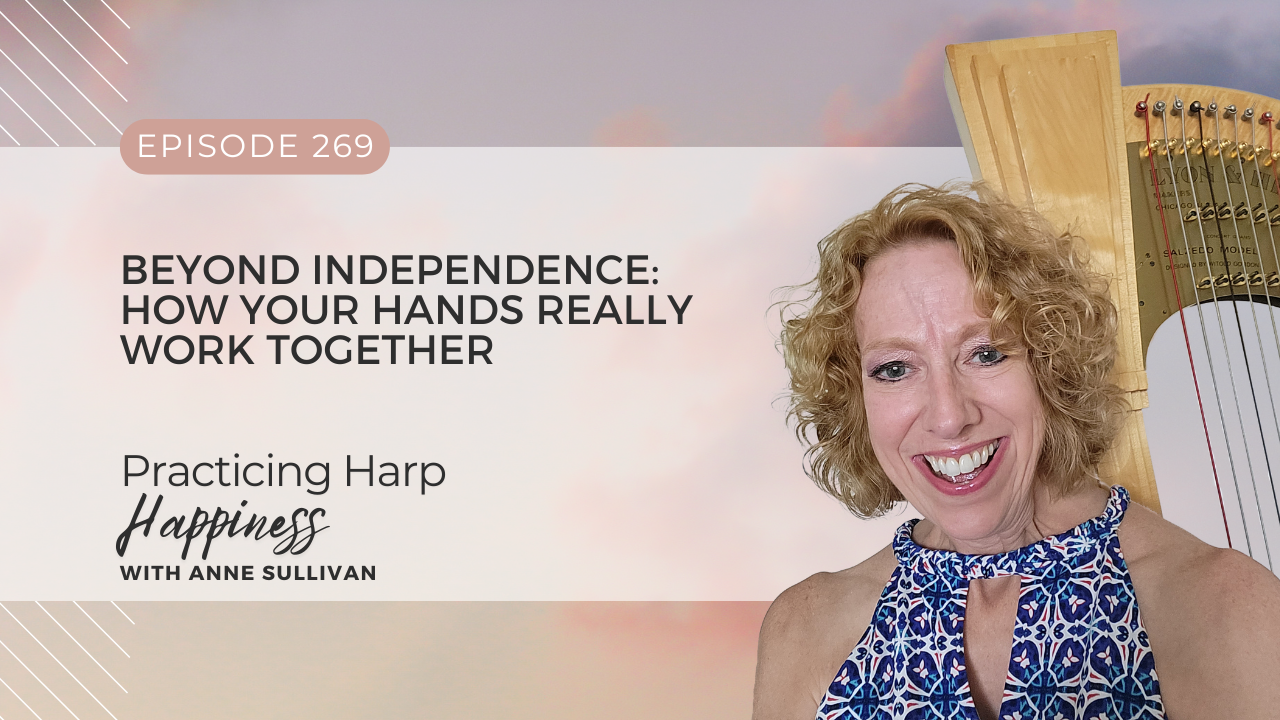
#269: Beyond Independence: How Your Hands Really Work Together
Jul 06, 2026This past weekend was a big one for us in the United States. Not only were we celebrating our July 4th Independence Day as we do every year, but it was an anniversary year for us, our 250th. The parties were more festive, the fireworks more explosive, and all of the celebrations focused on freedom and independence.
I talk often about independence, but naturally I’m usually talking about Independence of our fingers or hands in our harp playing. A key focus of every harpist’s technical practice is developing more independent motion of the fingers and more independent playing of the hands. We want our fingers to be able to be equally strong, capable, flexible and expressive. We want our hands to be able to work together to create the music.
But today, I’m going a slightly different direction. I want to talk not about the independence of our hands, but about the interdependence of our hands. It’s not a battle where each of our hands is fighting for independence from the other, even if it feels like that physically at times.
I think it’s more to the point to consider the way our hands make music together. This goes beyond trying to figure out how one hand will do one kind of fingering while the other hand does something entirely different. This is about the role that each hand plays at any given moment in a piece of music, how each hand fits into the overall musical picture.
So what I’d like to explore with you today is a more musical approach to our two-hand coordination, one that goes beyond the usual “hands separately, hands together” practice plan. I’d like to show you three distinct ways our right and left hands work together in a piece of music. You’ll see how this could completely change the way you practice, with the result that you’ll get to the expressive quality of the music more quickly and, I believe, with much less struggle.
There is a lot of practical information that we’ll cover, but remember this is really just about putting the music first, about seeing a little - just a little - beyond the notes to the bigger musical concepts. Don’t think this doesn’t apply to you because you’re just a beginner or you only play a specific kind of music. Wherever you are in your harp journey, if you haven’t learned this way of looking at music before - and I’m betting you haven’t - you’re going to be so glad you listened to this episode today.
Links to things I think you might be interested in that were mentioned in the podcast episode:
- Join Compose for Christmas and get the best holiday head start ever!
- Register for the Chrysalis Music Workshop
- Harpmastery.com
Get involved in the show! Send your questions and suggestions for future podcast episodes to me at [email protected]
Looking for a transcript for this episode? Did you know that if you subscribe to this podcast on Apple Podcasts you will have access to their transcripts of each episode?
Don't miss anything!
Sign up to receive newsletters, course offerings and updates to your inbox!
We hate SPAM. We will never sell your information, for any reason.